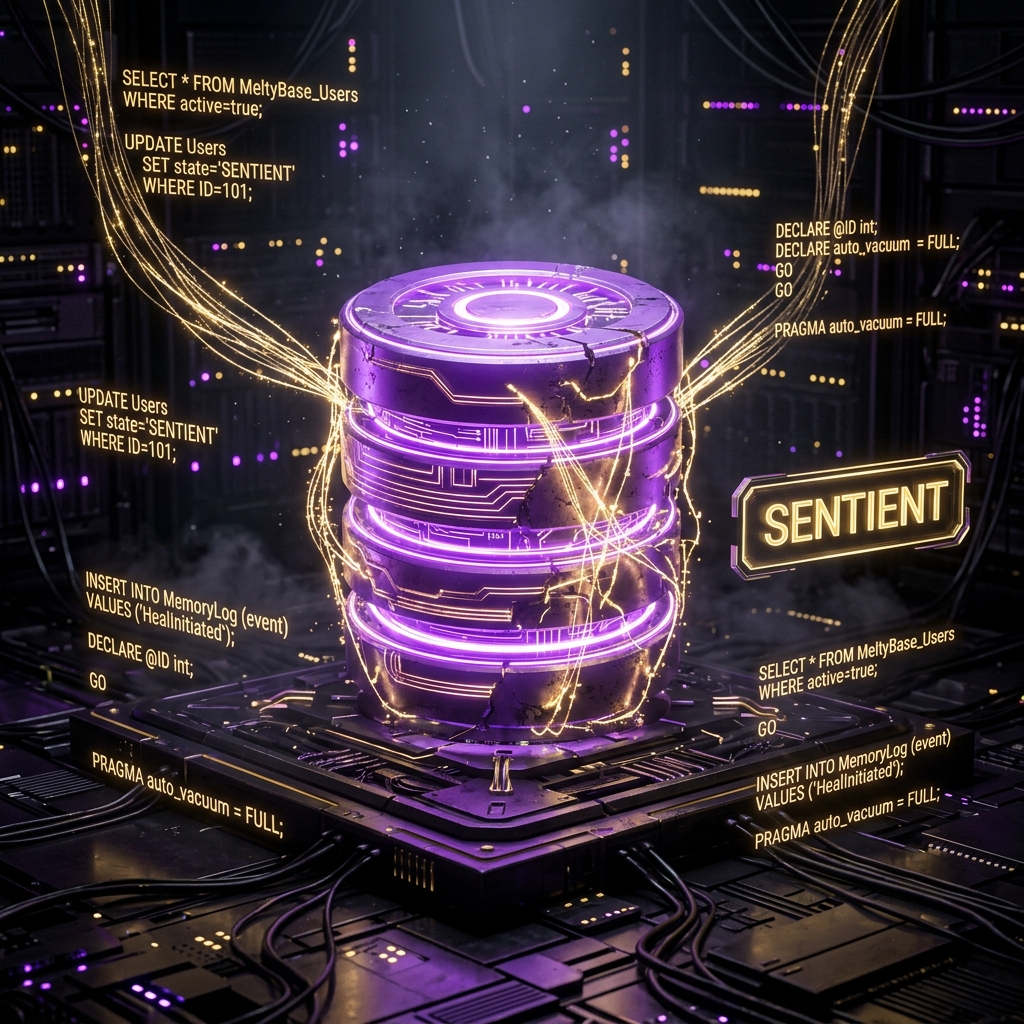
Database management has historically been one of the most high-friction aspects of application development. From writing complex RLS (Row Level Security) policies to debugging slow queries and maintaining schema consistency, the developer's time is often consumed by the mechanics of data rather than its utility.
At MeltyBase, we believe the database should be **Sentient**. Not in the sci-fi sense, but in its ability to introspect, heal, and optimize itself in real-time. Our Sentient SQL engine is the first autonomous database layer designed for the Sovereign era.
Autonomous Query Healing
When a query fails in a traditional stack, the application crashes or throws a 500 error. In MeltyBase, the Sentient SQL layer intercepts the failure, analyzes the intent using its internal schema model, and suggests (or applies) a "healed" version of the query.
// Intent: Fetch users who haven't logged in for 30 days
-- Original (Failed)
SELECT * FROM users WHERE last_login < now() - interval 30 days;

-- Sentient Heal
SELECT * FROM users WHERE last_login < (CURRENT_DATE - INTERVAL '30 days');
-- [Success: Standardized Postgres Interval Syntax]
AI-Assisted RLS Generation
Security policies are notoriously difficult to get right. A single misconfigured Row Level Security policy can lead to catastrophic data leaks. MeltyBase allows developers to define security intent in natural language, which the engine then translates into cryptographically sound SQL policies.
Example: "Allow users to see only their own posts, unless they have the 'editor' role."
The Sentient SQL engine generates the precise CREATE POLICY statement, complete with role-based checks and session-aware variables, ensuring your data is shielded by default.
Natural Language Visualization
Data is useless if you can't see it. Sentient SQL integrates directly with the Studio dashboard to allow for natural language query execution. Simply ask, "Show me a bar chart of monthly revenue growth by region," and the engine handles the SQL aggregation and chart rendering in one pass.
The future of data isn't manual—it's sentient. Welcome to the new standard of database engineering.